- Seal drafts first around windows and doors; it's the cheapest fix of all.
- Use a low-wattage heater (400–800 W) with a thermostat and timer instead of a 1,500 W heater on full blast.
- Heat yourself, not just the air: rugs, curtains, layers and a warm blanket make a lower setting feel comfortable.
- Only heat the room while you're in it.
If you spend most of the evening in one room, like a home office, bedroom or den, it makes little sense to pay to heat the entire house to the same temperature. Yet that's what most of us do every winter. Heating one room well instead of heating every room a little is one of the simplest ways to cut a winter energy bill without being cold. This guide explains how zone heating works, which heaters cost the least to run, what to do before you buy anything, and the habits that make the biggest difference.
Why is heating one room cheaper than heating the whole house?
Your heating bill depends on how much space you heat, how warm you keep it and how much heat escapes. Space heating is the biggest single energy use in many US homes, according to the U.S. Energy Information Administration. When you lower the central thermostat, every room loses heat more slowly, so the furnace or heat pump runs less. A small heater then adds warmth only where you're sitting.
The savings are biggest in houses where several rooms sit empty for most of the day: spare bedrooms, a formal dining room, a basement, or a second floor you only use at night.
What should you do before buying a heater?
The cheapest heat is the heat you don't lose. Start with these free or nearly free steps:
- Close the door of the room you're heating, and close vents in rooms you don't use (if your system allows it).
- Block drafts under doors with a draft stopper or a rolled towel.
- Seal window gaps with removable weatherstripping or rope caulk.
- Hang heavier curtains and close them at dusk; open them on sunny days to let the sun warm the room.
- Put down a rug on bare floors, which feel cold and pull heat from your feet.
- Move furniture away from exterior walls and windows, where it's coldest.
Even a small room heater works far better in a room that holds its warmth.
Which type of heater is cheapest to run?
All plug-in electric resistance heaters turn electricity into heat at essentially the same efficiency. What changes your bill is how many watts the heater draws and how long it runs. That's why a heater with a lower power range and a thermostat usually costs less to run than one that only has "high" and "low".
| Heater type | Typical power | Good for | Notes |
|---|---|---|---|
| Wall-mounted ceramic (e.g. Cozy Cove Pro) | 400–800 W | Bedrooms, offices, small living rooms | Off the floor, remote control, fast warmth |
| Floor ceramic fan heater | 750/1,500 W | Quick bursts of heat | Takes floor space; needs tip-over protection |
| Oil-filled radiator | 600–1,500 W | Steady background heat | Slow to warm up, heavy |
| Radiant/infrared | 500–1,500 W | Warming a person directly | Gets hot to the touch |
| Heated blanket or throw | Under 200 W | Couch or bed | Warms you, not the room |
How much does it cost to run a small heater?
To estimate the cost, multiply the heater's wattage by the hours you run it, divide by 1,000 to get kilowatt-hours (kWh), then multiply by your electricity rate. For example, with electricity at about 17 cents per kWh:
| Heater power | Cost per hour (at $0.17/kWh) | Cost for 4 hours a day, 30 days |
|---|---|---|
| 400 W | About $0.07 | About $8 |
| 800 W | About $0.14 | About $16 |
| 1,500 W | About $0.26 | About $31 |
Your rate may be higher or lower; check your electric bill for the exact number. And because a thermostat cycles the heater on and off once the room is warm, real-world costs are often lower than running at full power the whole time.
Why consider a wall-mounted heater like the Cozy Cove Pro?
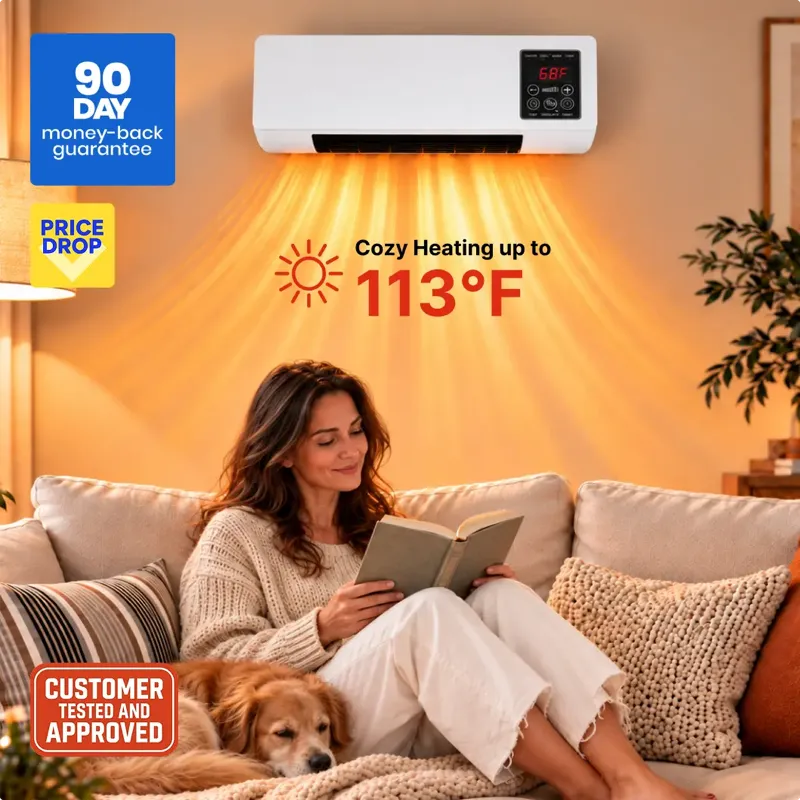
For a room you use every day, a wall-mounted heater is easy to live with. The Cozy Cove Pro uses PTC ceramic elements and a fan, runs between 400 and 800 watts, has a remote and a touch panel, and shuts itself off if it overheats. Mounted on the wall, it keeps the floor clear, stays out of reach of kids and pets, and spreads warm air across the room instead of pooling at your feet.
It costs $99.99 for one, $79.99 each for two and $59.99 each for three, ships from a US warehouse and comes with a 90-day money-back guarantee. Read the details in our Cozy Cove Pro review.
Warm the room you're in, not the whole house
The Cozy Cove Pro runs at 400–800 W with a remote and overheat shut-off. From $59.99 each in bundles, with a 90-day money-back guarantee.
Check today's price →$99.99, or from $59.99 each in bundles · 90-day guarantee
How should you set the central thermostat?
A common approach is to lower the main thermostat a few degrees during the day and a bit more at night, then use the room heater to bring your room up to a comfortable temperature. Don't turn the central heat off completely in freezing weather: pipes in unheated areas can freeze. Keep the rest of the house cool, not cold.
If you have a programmable or smart thermostat, schedule it to drop while you're at work or asleep and rise shortly before you need it.
Which habits save the most money?
- Run the heater only while you're in the room. Use a timer if it has one.
- Pick a sensible setting. Each degree you don't heat saves energy.
- Preheat for 10 minutes, then let the thermostat maintain the temperature.
- Dress for winter indoors: warm socks, a sweater and slippers let you feel comfortable at a lower temperature.
- Use a blanket on the couch or a heated throw for long, still evenings.
- Keep doors closed so the heat stays where you want it.
How do you use a room heater safely?
Heating equipment is a leading cause of home fires in winter, according to the National Fire Protection Association, usually because something flammable is too close. Follow these rules with any heater:
- Plug it directly into a wall outlet, never an extension cord or power strip.
- Keep at least 3 feet of clear space around it.
- Choose a model with overheat protection; floor models should also have tip-over shut-off.
- Don't dry clothes on it or cover it.
- Turn it off when you leave the room or go to sleep.
- Keep working smoke alarms on every floor.
Which rooms benefit most from a small heater?
- Home offices, where you sit still for hours.
- Bedrooms, especially over a garage or on a north-facing side.
- Bathrooms before a morning shower (use only heaters rated for bathrooms).
- Basements and finished garages that the central system barely reaches.
- Nurseries, where an off-the-floor heater keeps little hands away.
What mistakes make room heating expensive?
- Running a 1,500 W heater all day in a drafty room.
- Leaving the central thermostat just as high while also running a heater.
- Heating a room with the door wide open.
- Leaving the heater on in an empty room.
- Buying several cheap heaters instead of one good one with a thermostat.
What if the power goes out?
Electric heaters stop working in a power outage, so have a backup plan: extra blankets, warm layers, a closed-off room where everyone gathers, and never use grills or generators indoors. Our guide on how to prepare for the first snow covers a simple winter kit, and battery tools in cold weather explains how to keep cordless gear ready.
Can you use the same approach in a garage or workshop?
Yes. A garage workshop is a classic "one room" problem: you don't need it warm all day, only for the hour or two you're working. Insulating the garage door, sealing gaps and using a heater only while you're there keeps costs down. Keep any heater well away from fuel, solvents, sawdust and rags. Before winter, it's also worth giving the space a clean-out; see how to clean a garage.
Is a room heater a good gift?
For someone who's always cold, works from home or lives in an older, drafty house, a small, safe room heater is one of the most practical winter gifts. Look for overheat protection, a thermostat and easy controls. See more ideas in our Christmas gifts for homeowners.
How do you find your own electricity rate?
Look at the "price per kWh" or "energy charge" line on your electric bill. Some utilities add delivery charges separately; add them together for a realistic number, then use the formula above to estimate what any heater will cost you per hour.
The bottom line
The cheapest way to heat one room is to stop heating the rooms you're not using. Seal drafts, close the door, lower the central thermostat a few degrees and add warmth only where you sit with a low-wattage heater that has a thermostat and overheat protection. A 400 to 800 W wall-mounted heater like the Cozy Cove Pro keeps the floor clear, works from a remote and costs a fraction of heating the whole house, so you stay comfortable without dreading the next bill.
Our pick: the Cozy Cove Pro Wall Heater
Ceramic (PTC) heater with a remote and touch panel. Mounts on the wall or sits on a surface, with overheat auto shut-off. Ships from a US warehouse.
Check today's price →$99.99, or from $59.99 each in bundles · 90-day guarantee
- U.S. Energy Information Administration. Use of energy in homes.
- National Fire Protection Association. Heating safety.
Frequently asked questions
What is the cheapest way to heat one room?
Lower the central thermostat, seal drafts and use a low-wattage heater with a thermostat only while you're in the room.
Is it cheaper to run a space heater than central heat?
Often yes for one room, if you turn the central heat down and only heat the room you use.
How much does an 800 watt heater cost to run?
About 14 cents an hour at 17 cents per kWh; check your own electricity rate.
Which electric heater is most efficient?
Plug-in resistance heaters are similarly efficient; lower wattage, a thermostat and a timer cut the cost.
Is a wall-mounted heater better than a floor heater?
It keeps the floor clear, is harder to knock over and spreads warm air across the room.
Can I plug a heater into an extension cord?
No. Plug heaters directly into a wall outlet.

Tim Humbert
Tim looks into the viral gadgets that show up in your feed, from mini leaf blowers to chain sharpeners and car care cloths. He reads the product pages, checkout and return policies, and buyer feedback so you know what a gadget really does before you spend money on it. His reviews are built on manufacturer information, official checkout and return policies, trusted safety sources and buyer feedback, and are updated when offers change. More about Tim.