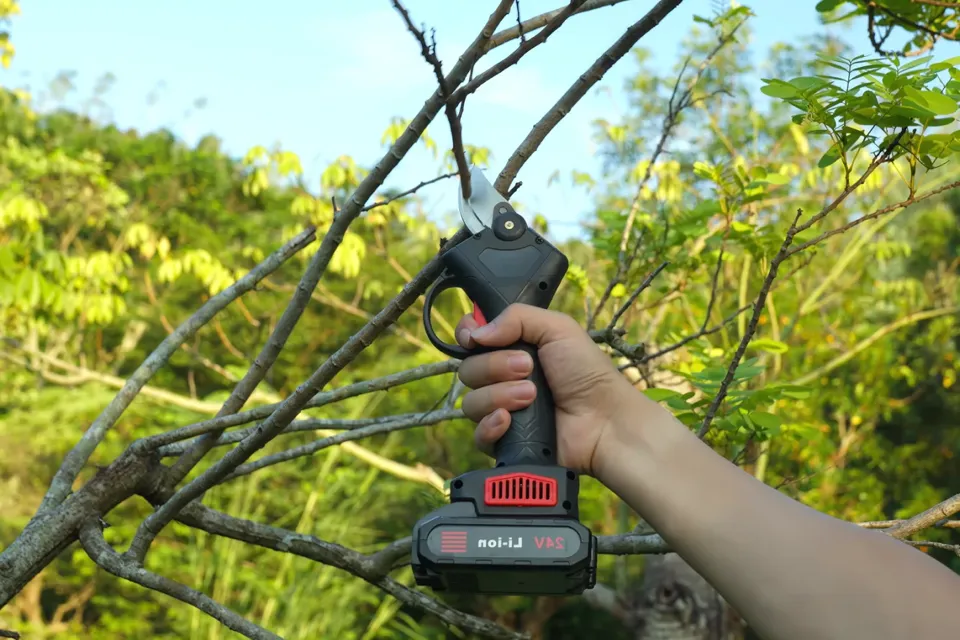
Electric pruning shears used to be a tool for vineyards and commercial orchards, where workers make thousands of cuts a day. Now compact, cordless versions show up in social media ads for home gardeners, promising effortless one-hand pruning. So do they really work, or are they a gimmick?
In this guide we explain how electric pruners work, what they can and can't cut, how they compare with manual pruners and loppers, battery life, safety and who they make sense for. We based it on manufacturer specs, pruning guidance from university extension services and what buyers report.
How do electric pruning shears work?
An electric pruner has the same basic shape as a pair of hand pruners, but the handle holds a small motor and gearbox and the bottom holds a rechargeable battery. When you pull the trigger, the motor drives the moving blade closed with far more force than most hands can produce, then opens it again for the next cut.
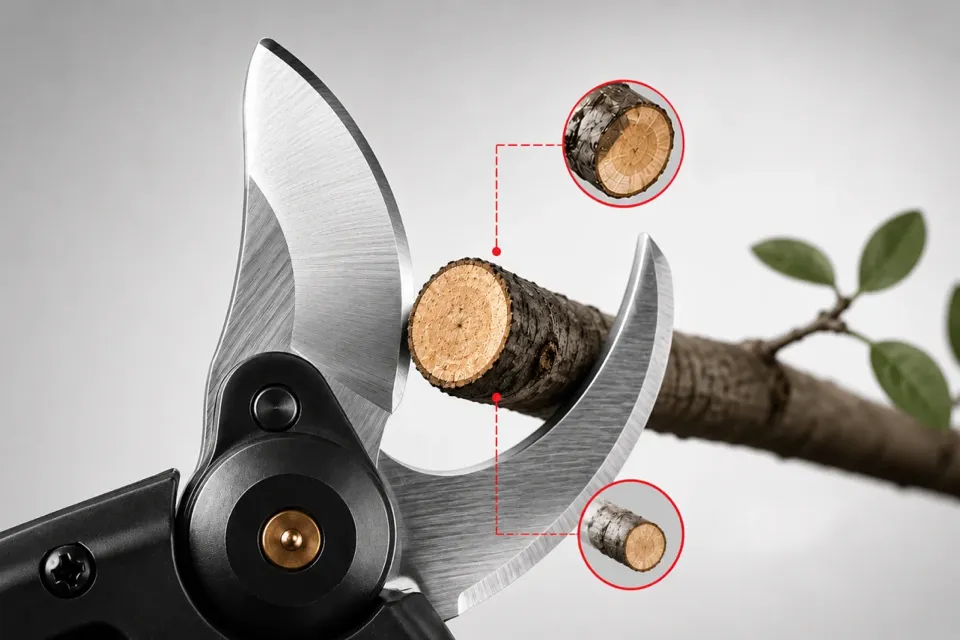
Most home models use a bypass design: the sharp upper blade slides past a lower hook, like scissors. That's the cut most gardeners prefer for live wood, because it slices cleanly instead of crushing the stem.
Because the motor supplies the force, the only thing your hand does is hold the tool and press a trigger. That's the whole idea: the same cut, without the squeeze.
How thick a branch can electric pruners cut?
It depends on the model, but compact cordless pruners for home use typically cut branches from about 1 inch up to about 1.5 inches. The Wood Ranger Power Shears, for example, are rated for branches up to about 1.4 inches.
Compare that with manual tools. The University of Minnesota Extension says hand pruning shears are meant for cuts up to about 3/4 inch, and long-handled loppers for branches up to about 1 1/2 inches. Hand saws take over above that.
| Tool | Typical max branch | Effort |
|---|---|---|
| Manual hand pruners | About 3/4 in | Squeeze every cut |
| Cordless electric pruners | About 1 to 1.5 in | Trigger pull |
| Loppers (two hands) | About 1 1/2 in | Two-arm push |
| Pruning saw | Over 1 in, up to several inches | Sawing |
So a good electric pruner covers your hand pruners' jobs and most of your loppers' jobs, in a tool you can use with one hand. That's why so many owners say they rarely pick up the loppers anymore.
Are electric pruners better for arthritis and sore hands?
For many people, this is the main reason to buy one. Repetitive squeezing is hard on the small joints of the hand and wrist. After a long pruning session with manual shears, sore fingers, a stiff wrist or a tingling hand are common, and for people with arthritis or carpal tunnel it can make pruning painful.
The Arthritis Foundation recommends choosing easy-to-grip tools, letting your larger joints do the work and taking regular breaks. An electric pruner takes the hardest part, the grip force, off your hand completely. You still need to hold the tool, so pick a light one and rest when you need to.
That's why electric pruners have become popular gifts for older parents who love their gardens but struggle with manual tools.
Do electric pruners make clean cuts?
Yes, as long as the blades are sharp and you use them within their rated capacity. A powered bypass blade closes in one smooth motion, so you don't get the half-cut, twisted stems that happen when your hand gives out halfway through a tough branch.
Clean cuts matter. A smooth cut just outside the branch collar seals over faster than a torn or crushed one, which is better for the plant. Look for hardened steel blades, such as SK5, that hold an edge, and wipe them clean after each session.
How long does the battery last?
Most compact cordless pruners run about 30 minutes to a couple of hours, depending on battery size and how hard you work them. The Wood Ranger Power Shears are rated at about 30 minutes and recharge in under an hour.
Runtime is measured while the motor is working, and the motor only runs during cuts. Most of a pruning session is spent looking, moving and clearing cuttings, so 30 minutes of motor time covers a good amount of real work: several rose bushes, a row of shrubs or a couple of small fruit trees. For an orchard or a long hedge, a spare battery lets you keep going.
What can't electric pruning shears do?
Being realistic about limits is the best way to be happy with any tool:
- Thick limbs. Anything over the rated capacity, usually about 1.4 to 1.5 inches, needs a pruning saw or chainsaw.
- Tall branches. They're handheld. For high branches use a pole pruner, and never prune above your shoulders on a ladder.
- Hedge shearing. Pruners make individual cuts. For flat-topping a long formal hedge, a hedge trimmer is faster.
- Very dry, dead hardwood near the top of the range takes more effort than green wood.
Within those limits, they're one of the most useful upgrades a home gardener can make.
Are electric pruners safe?
They're safe when you treat them like any cutting tool. The motor closes the blade with real force, so it will cut a finger as easily as a branch. Good models include a safety lock: the Wood Ranger Power Shears, for example, need a quick double-click of the trigger to power on, which helps prevent accidental cuts.
- Keep your free hand behind the blade, never in front of it.
- Wear gloves and safety glasses.
- Switch off before you set the tool down, change the battery or clear a jam.
- Store it out of reach of children.
Which jobs go fastest with an electric pruner?
The more cuts a job needs, the bigger the difference. These are the jobs where owners notice it most:
- Grape vines. Winter cane pruning means cutting back almost all of last year's growth, often hundreds of cuts per vine row. This is the job electric pruners were originally invented for.
- Fruit trees. Thinning an apple or pear tree means removing water sprouts, crossing branches and inward growth, many of them in the 1/2 to 1 inch range that's hard work by hand.
- Rose beds. Thick, thorny canes, lots of them, and you want a clean cut every time.
- Overgrown shrubs. Renewal pruning removes the oldest, thickest stems at the base, exactly the size that makes hand pruners struggle.
- Storm cleanup. Cutting fallen branches into pieces that fit the yard-waste bin goes much faster with a trigger than with loppers.
- Berry canes. Removing the old raspberry and blackberry canes after harvest is quick, repetitive work.
On the other hand, if your pruning is a few minutes of deadheading flowers and snipping herbs, a small pair of hand snips is all you need.
Are electric pruning shears worth it?
For most people who prune more than a few minutes at a time, yes. Here's a quick way to decide:
| Your situation | Electric pruner worth it? |
|---|---|
| Fruit trees, roses, vines or many shrubs | Yes, big time saver |
| Arthritis, weak grip or sore wrists | Yes, the main reason to buy |
| You keep switching between pruners and loppers | Yes, one tool for both |
| Storm cleanup with lots of small branches | Yes |
| A few flower stems a year | Hand pruners are enough |
| Mostly limbs thicker than 1.5 in | Get a saw or chainsaw |
What's the best electric pruner for home use?
Our pick is the Wood Ranger Power Shears. They hit the sweet spot for home gardeners:
- SK5 hardened steel bypass blades, plus a spare blade in the box
- Cuts branches up to about 1.4 inches
- 2.1 lb, cordless, 24V battery with about 30 minutes of runtime
- Double-click safety trigger
- Ships from Ohio with a 90-day money-back guarantee
- $79.99, or as low as $47.99 each in bundles
Read our full Wood Ranger Power Shears review for specs, prices and our 4.5/5 verdict.
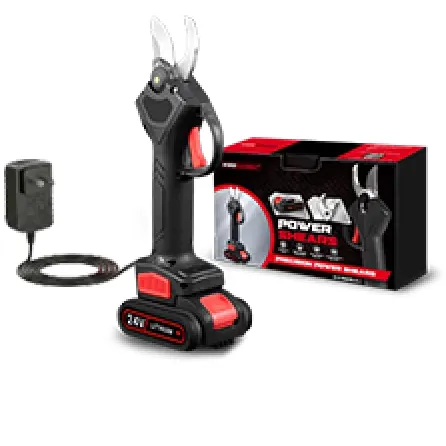
Our pick: the Wood Ranger Power Shears
2.1 lb cordless pruning shears with SK5 steel blades, a 24V battery and a safety trigger. Cuts branches up to about 1.4 in. Ships from Ohio.
Check today's price →From $47.99 each in bundles · 90-day guarantee
What should you look for when buying electric pruners?
- Cutting capacity. At least 1 inch, ideally 1.4 to 1.5 inches, so you can retire the loppers.
- Blade steel. Hardened steel like SK5 holds an edge longer. A spare blade is a bonus.
- Weight. Around 2 lb is comfortable for one-hand use over a long session.
- Safety lock. A trigger lock or power button prevents accidental cuts.
- Battery. A removable battery means you can buy a spare and swap.
- Guarantee and support. A long return window and a US contact make a big difference with any gadget.
How do you prune with electric shears?
- Charge the battery fully and check that the blades are clean and tight.
- Start with dead, broken and diseased branches. Those can go any time of year.
- Then remove crossing and rubbing branches and anything growing toward the center.
- Cut about 1/4 inch above an outward-facing bud, or just outside the branch collar. Don't leave stubs.
- Don't remove too much at once. The UMN Extension advises never removing more than about a quarter of a tree's live foliage in one go.
- Clean the blades with rubbing alcohol when moving from a diseased plant to a healthy one.
Timing matters as much as technique. See what to prune in fall (and what to leave).
More yard guides
- Wood Ranger Power Shears review
- Electric vs manual pruning shears
- Wood Ranger leaf blower review
- Fall yard cleanup checklist
- Is Wood Ranger legit?
The bottom line
Electric pruning shears are not a gimmick. They take the grip strength out of pruning, cut further than hand pruners and make big jobs like fruit trees, roses and vines much faster and easier on your hands. Use a saw for thick limbs and a pole tool for high ones, and an electric pruner will handle almost everything else.
If you're ready to try one, our pick is the Wood Ranger Power Shears, with a 90-day money-back guarantee.
Sources
- University of Minnesota Extension. Pruning trees and shrubs.
- Arthritis Foundation. Gardening with arthritis.
- Official Wood Ranger Power Shears product page and checkout, checked October 2026.
Frequently asked questions
Are electric pruning shears worth it?
For anyone who prunes fruit trees, roses, vines or lots of shrubs, or has sore hands, yes. They cut thicker branches than hand pruners and do the squeezing for you.
How thick can electric pruners cut?
Compact cordless pruners for home use typically cut branches from about 1 inch up to about 1.5 inches. The Wood Ranger Power Shears are rated up to about 1.4 inches.
Do electric pruners help with arthritis?
Yes. The motor supplies the cutting force, so your fingers and wrist don't have to squeeze, which is the hardest part of pruning for people with arthritis.
How long do cordless pruner batteries last?
Most run about 30 minutes to a couple of hours of motor time. Because the motor only runs during cuts, 30 minutes covers a good amount of real pruning.
Are electric pruning shears dangerous?
They close with real force, so treat them like any cutting tool: keep your free hand away, wear gloves and glasses, and use a model with a safety lock.
Can electric pruners replace loppers?
For most home jobs, yes. A pruner rated to about 1.4 to 1.5 inches covers nearly the same range as loppers, with one hand instead of two.
What's the best electric pruner for home use?
Our pick is the Wood Ranger Power Shears: SK5 blades, cuts up to about 1.4 in, 2.1 lb, about 30 minutes per charge and a 90-day guarantee, from $47.99 each in bundles.

Tim Humbert
Tim looks into the viral gadgets that show up in your feed, from mini leaf blowers to chain sharpeners and car care cloths. He reads the product pages, checkout and return policies, and buyer feedback so you know what a gadget really does before you spend money on it. His reviews are built on manufacturer information, official checkout and return policies, trusted safety sources and buyer feedback, and are updated when offers change. More about Tim.