- The filing angle marked on the chain or listed by the manufacturer.
- The file size that matches your chain (commonly 5/32, 3/16 or 7/32 in).
- The depth gauge setting, filed down only when needed.
A sharp chain cuts fast, throws chips instead of dust and needs very little pushing. A chain sharpened at the wrong angle cuts crooked, chatters, dulls quickly and can even raise the risk of kickback. Getting the angle right is the single most important part of sharpening, and it's easier than it looks once you understand the three angles involved.
This guide explains the angles that matter, how to find the right one for your chain, how to hold the file, how depth gauges work, how to keep every tooth the same and how a guided sharpener helps.
What angles matter when sharpening a chainsaw chain?
| Angle | What it is | Typical value |
|---|---|---|
| Top-plate filing angle | The angle of the file across the top of the cutter, seen from above | Usually 30°, sometimes 25° or 35°; 10° for ripping chains |
| Vertical (down) angle | Whether the file is level or tilted, seen from the side | Usually 0° (level) or about 10° on some chains |
| Side plate angle | The shape of the cutter's side, created by file height and size | Comes from using the right file diameter and holding it at the right height |
The top-plate angle is the one most people mean when they talk about "sharpening angle." Oregon, one of the largest chain makers, publishes filing angles and file sizes for each chain type.
How do you find the right angle for your chain?
- Look at the chain: many cutters have a witness mark or line on top showing the factory angle.
- Check the chain's model number, usually stamped on the drive links or printed on the packaging, then look it up on the manufacturer's site.
- Check your saw's manual, which lists the chain type and sharpening specs.
- Ask at a hardware or outdoor power store with the chain in hand.
When in doubt, 30 degrees with a level file is the most common setting for standard homeowner chains.
Which file size do you need?
| Chain pitch | Common file size |
|---|---|
| 1/4 in | 5/32 in (4.0 mm) |
| 3/8 in low profile | 5/32 in (4.0 mm) |
| .325 in | 3/16 in (4.8 mm) |
| 3/8 in standard | 7/32 in (5.5 mm) |
| .404 in | 7/32 in (5.5 mm) |
These are typical pairings; always confirm with your chain's specs. A file that's too small digs a hook into the cutter, and one that's too big leaves a blunt edge.
How do you hold the file at the right angle?
- Hold the file level, at 90 degrees to the bar, unless your chain calls for a down angle.
- Turn the file to the top-plate angle (for example 30 degrees) relative to a line straight across the bar.
- Keep about one-fifth of the file diameter above the top plate.
- File from the inside of the cutter toward the outside, pushing forward only.
- Use the same number of smooth strokes on every tooth.
A file guide with angle lines printed on it helps freehand sharpening. Our step-by-step guide: how to sharpen a chainsaw with a file.
Why must every tooth be the same?
A chain has cutters on the left and the right. If one side is sharpened at a sharper angle or filed shorter than the other, that side cuts more aggressively and the saw pulls to one side. That's the most common reason a chainsaw cuts crooked. See why a chainsaw cuts crooked.
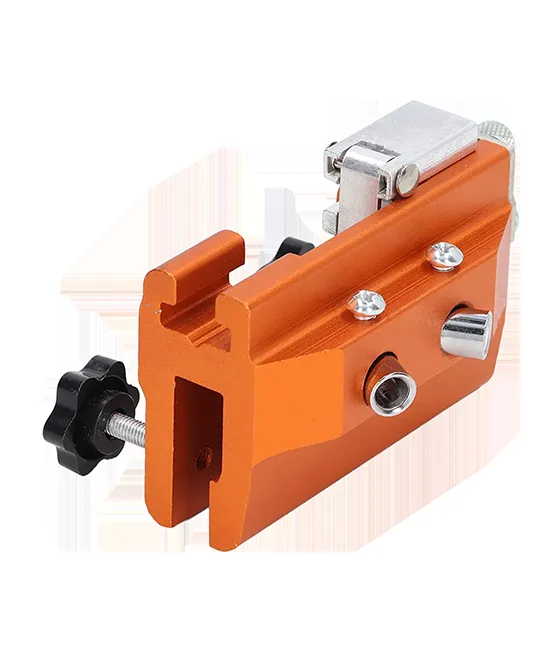
Sharpen every tooth at the same angle
SawShark hand-crank sharpener: clamps to your bar, guides every tooth at the same angle, no power needed. $29.95, or from $17.97 each in bundles.
Check today's price →$29.95, or from $17.97 each in bundles
How does a guided sharpener help?
Keeping the same angle and depth on 50 or more cutters is hard freehand, especially outdoors or when your hands are tired. A guided sharpener locks the angle for you. SawShark is a hand-crank sharpener that clamps to the bar and guides each tooth at the same angle, with no power needed, so it works in the woodpile or at a job site. It's a simple way to keep a chain sharp between professional grinds. Read our SawShark review and how to sharpen a chainsaw.
What are depth gauges and when should you file them?
In front of each cutter is a small hump called the depth gauge (or raker). It controls how deep the cutter bites. As you sharpen the cutters, they get slightly lower, so after several sharpenings the depth gauges need a light filing with a flat file and a depth gauge tool. File them too low and the chain grabs and can increase kickback; leave them too high and the chain won't cut well. Check them every three or four sharpenings.
What about ripping chains and different angles?
Ripping chains, used for cutting along the grain (for example, milling lumber), are filed at a much smaller angle, about 10 degrees. Some chains for hard or frozen wood use 25 degrees for a more durable edge, and some aggressive chains use 35. Stick to the manufacturer's angle for everyday cutting.
How do you know the angle is wrong?
- The saw cuts crooked or pulls to one side.
- The chain makes fine dust instead of chips.
- You have to push hard to cut.
- The chain dulls very quickly after sharpening.
- The saw chatters or vibrates more than usual.
More in signs a chainsaw chain is dull.
What safety steps matter when sharpening?
- Turn the saw off, and for gas saws, let it cool. For electric saws, remove the battery or unplug.
- Engage the chain brake while sharpening, releasing it only to advance the chain.
- Wear cut-resistant gloves.
- Clamp the bar in a vise or use a bar-mounted sharpener for stability.
The OSHA chain saw safety fact sheet covers safe handling, and CCOHS explains how chain condition relates to kickback.
How often should you sharpen?
Many users touch up the chain after every tank of fuel or battery charge, or whenever it starts making dust. Hitting dirt, rocks or nails dulls a chain instantly. See how often to sharpen a chainsaw chain.
How much does SawShark cost?
SawShark is $29.95 for one, $26.95 each for two, $23.36 each for three and $17.97 each for four. Returns are accepted within 30 days for products in original condition.
Can you sharpen at the right angle freehand?
Yes, with practice. Many experienced users sharpen freehand by watching the witness marks and counting strokes. Beginners usually get better results with a file guide or a bar-mounted sharpener, because small changes in angle from tooth to tooth are hard to see but easy to feel when the saw starts pulling. A good habit is to sharpen all the cutters on one side first, then turn around and do the other side, keeping your body position the same.
Should you change the angle for frozen or dirty wood?
Some users choose a slightly smaller top-plate angle, such as 25 degrees, for frozen or very hard wood, since a less aggressive edge holds up longer. For dirty wood, like logs that were dragged through mud, the best fix is to clean or debark the cut area first, because grit dulls any edge quickly. For everyday firewood cutting, stay with the manufacturer's angle.
Is an electric grinder better?
Bench grinders are fast and accurate for badly damaged chains, and many shops use them. But they remove more metal and can overheat cutters if used aggressively, shortening the chain's life. For regular touch-ups, a file or hand-crank sharpener removes just enough metal and can be used right where you're working. See chainsaw maintenance.
When should you replace the chain instead?
Replace the chain when cutters are filed down to the wear mark, teeth are cracked or broken, or the chain has stretched so much that it can't be tensioned. A chain that keeps coming off may also be worn out; see why a chainsaw chain keeps coming off.
What's a quick angle checklist before you start?
- Chain model and pitch identified.
- Correct round file size and a flat file for depth gauges.
- Top-plate angle confirmed (usually 30 degrees).
- File held level unless the chain calls for a down angle.
- Bar clamped or sharpener attached.
- Chain brake on, saw off and cool.
Does a new chain need sharpening?
A new chain comes sharp from the factory, at the correct angle. Use those fresh cutters as your reference: look closely at the angle and the shape of the edge before your first sharpening, and aim to recreate it each time. Taking a photo of a new cutter is a simple way to remember what "right" looks like.
The bottom line
Most chains are sharpened at a 30-degree top-plate angle with a level file of the right diameter, but always check your chain's specs. Keep every tooth the same angle and length, check the depth gauges every few sharpenings and work safely. A guided sharpener takes the guesswork out of the angle.
For consistent angles in the field, our pick is SawShark. Check today's SawShark price.
Sources
- Oregon. Sharpening Chainsaw Chain.
- OSHA. Chain Saw Safety.
- CCOHS. Chainsaws: Kickback.
- Official SawShark product page, checked October 2026.
Frequently asked questions
What angle do you sharpen a chainsaw chain?
Most standard chains use a 30-degree top-plate angle with the file held level.
What angle is used for ripping chains?
About 10 degrees, for cutting along the grain.
What file size do I need?
It depends on chain pitch; 3/8 in standard chains commonly use a 7/32 in file.
Why does my chainsaw cut crooked after sharpening?
The left and right cutters were likely sharpened at different angles or lengths.
How often should I file the depth gauges?
Check them every three or four sharpenings.
Does a guided sharpener help?
Yes, it keeps the same angle on every tooth, which is hard to do freehand.

Tim Humbert
Tim looks into the viral gadgets that show up in your feed, from mini leaf blowers to chain sharpeners and car care cloths. He reads the product pages, checkout and return policies, and buyer feedback so you know what a gadget really does before you spend money on it. His reviews are built on manufacturer information, official checkout and return policies, trusted safety sources and buyer feedback, and are updated when offers change. More about Tim.